
Tuesday, March 29, 2022

Sunday, March 13, 2022
24 February 2022
Father, Father tell me why
these fires of crimson cross the sky,
revealing horsemen all aglow
with weapons at the saddlebow.
The flames are pyres of Pestilence,
the worm that rides by night and day,
that hurdles thorny hedge and fence,
to fall on unsuspecting prey.
Look! Stamping on the burning earth,
you see the rough-shod steed of War,
whose rider was a god at birth
now changed to something all abhor.
There, equally to be reviled,
rides one to wither grain and grass
called Famine, War’s unsightly child,
with eyes as pitiless as glass.
With fury’s fever gone at last
comes Death to rake the smoking embers;
to tamp them down into the past
until nobody quite remembers.
these fires of crimson cross the sky,
revealing horsemen all aglow
with weapons at the saddlebow.
The flames are pyres of Pestilence,
the worm that rides by night and day,
that hurdles thorny hedge and fence,
to fall on unsuspecting prey.
Look! Stamping on the burning earth,
you see the rough-shod steed of War,
whose rider was a god at birth
now changed to something all abhor.
There, equally to be reviled,
rides one to wither grain and grass
called Famine, War’s unsightly child,
with eyes as pitiless as glass.
With fury’s fever gone at last
comes Death to rake the smoking embers;
to tamp them down into the past
until nobody quite remembers.
Sunday, February 6, 2022

Painting Father
A grainy photo, shot in sandy hills:
I catch a glimpse of Dad in World War One,
unwounded yet, untouched by peacetime ills.
He smokes a fag, his tunic is undone;
expressing discontent, perhaps disease.
It’s otherwise a well turned-out parade:
the London Rifles smartly stand at ease,
the Lewis gun on legs correctly laid.
For poetry and paint to flow in tune
it’s better to be lucky than inspired;
as I portray him on his dusty dune
my Lady Fortune’s graces are required
but suddenly he’s here. I feel his breath.
A moment only, he returns to death.
On watching a video made by Isao Hashimoto
Cassandra knows she’s listened to no more
but still I hear her crying in the wind,
in fear of fierce white horses far offshore.
Her eyes are wild, her ragged hair unpinned.
She shouts a warning of calamity and war.
She sees the incarnation of her fears
on ocean’s edge, where sea and sky are twinned,
where keen eyes catch the flash of shields and spears.
She hears the grind of keels upon the sand;
the savage rush and tumult of the Greeks;
the missile rain of rock and firebrand;
the storming of the city; dying shrieks.
Cassandra’s warning is a waste of breath
but contemplate this catalogue of death
www./youtube/WANQrqg-W
Friday, October 15, 2021
On watching a video made by Isao Hashimoto
Cassandra knows she’s listened to no more
but still I hear her crying in the wind,
in fear of fierce white horses far offshore.
Her eyes are wild, her ragged hair unpinned.
She shouts a warning of calamity and war.
She sees the incarnation of her fears
far out to sea, where wave and cloud are twinned,
where keen eyes catch the flash of shields and spears.
She hears the grind of keels upon the sand;
the savage rush and tumult of the Greeks;
the missile rain of rock and firebrand;
the storming of the city; dying shrieks.
Cassandra’s warning is a waste of breath
but contemplate this catalogue of death
www./youtube/WANQrqg-W
Monday, September 20, 2021
Love lines
I see her love lines curve and zoom
in shades of blue all round the room.
They turn and sweep, now wide and slow,
now fast and thin, now high, now low.
The best of love lines to be seen
are hers, to show that she is Queen.
Her lines are wise and strong; they wind
their way through any block they find.
Their touch is soft but when it’s felt
stone walls go soft, turn pale and melt
to let a flood of grace pass through
from glad, new worlds we dimly view.
I light with joy to hear her voice
and wait in hope to know her choice.
On reading Catherine Mansfield’s ‘Bliss’
‘Why must it Always be Tomato Soup?’
a question worthy of the drills of Zen;
like ’What is bliss?’ and other thoughts that troop
unanswered through the cluttered minds of men.
Bliss comes from common things, no need of thrills:
we make tomato soup for friends and dine
or plant a sunny spot with daffodils
and then this joyful light begins to shine.
To shop exquisitely is happiness
for those endowed with ample energy and wealth
but not complacent in their state of bliss
for ruin ever watches us in stealth
while those white horses, far off from the shore,
like creeping cats, could turn to tsunami,
to car and corpses soup and muck galore,
that sweeps away our final ecstasy.
Thursday, August 26, 2021
Lincoln Cathedral Choir
Once on a time we climbed Steep Hill and stood
before the quiet carvings in the choir.
For you loved poetry spelled out in wood:
the angels, pipes, the King, the drum, the lyre,
miserichords of toughened heart of oak…
Among these masterpieces, stall to stall,
each craftsman added his religious joke,
till plague arrived and put an end to all.
So here and there, some blocks are chisel-spared,
abandoned, lumpen logs, or if you will
are limitless potentials, left prepared
for handy chance and time to shape skill.
Since chance is quite as infinite as time
perhaps we’ll go again, up that steep climb.
Wednesday, February 24, 2021
On forging a sword
Wayland the Wanderer taught us how to find
the tough, bright iron, never prey to rust,
that not from earth but from the sky is mined
but for myself I’d sooner put my trust
in crucibles and bright electric arcs
with iron, carbon, tungsten, manganese,
vanadium… assayed by fiery sparks
and spectrographs. We mix them as we please,
surpassing any ancient recipe,
katana of Japan, Toledo steel,
in fiery melts, controlled to fine degree.
We get our billet, stamped with maker’s seal
and those proportions that the chemist found,
in heavy bars of alloy, shiny, round.
It is the time for glowing steel and prayers.
A dragon’s breath comes flaming from the hearth,
exhaling poisons in sulphurous flares.
We lay the billet in its burning bath
until with cheerful red it glows but not
that brilliant lustre with which iron burns,
consuming it to dust in fire too hot.
The bellows moderates, the colour turns.
Red-hot from hearth it crinkles empty air.
It eats all flesh and so we dread its touch,
however leather-skinned, and yet we dare
to hold and carry it with iron clutch.
Unto its sister where the hammer swings,
the billet flattens and the anvil sings.
Unyielding mother of the shining sword,
the anvil has a merry tone and clear.
Her warlike rhythms ring out chord by chord
to shape the weapons of the chevalier.
She turns to a harmonious refrain
that pierces to the heights of heaven’s clouds.
Musicians listen, play the theme again,
in far-off cities to delighted crowds.
The billet bends beneath the hammer blows
to sickle shape, a section of a wedge,
the nascent figure that the craftsman knows
will straighten out to form a cutting edge.
We hear the swish of tyres in the rain,
the sough of pebbles on the stormy beach.
The best of steel is quenched in warm champagne
to dull its colour from the cherry-peach.
Unwillingly it takes the curse of Cain
in busy bubbles, clouds of scolding steam,
and hisses sibilant, a viper’s scream
and then it’s sullen, cold and rough of coat,
embrittled as the thinnest champagne glass
but innocent of threat to any throat
and fit for cutting neither flesh nor grass.
It’s now reheated, scratched with brick to show
the oxide colours: Oxford blue for blades
that do not break but bend beneath a blow.
Light blue to give the edge that never fades
but there are secrets that cannot be told
of different tempers, using clay and oil,
of shattering to shards, of fold on fold
to forge anew with added sweat and toil.
Some things are governed by a rule of three:
blade, edge and tang make up the trinity.
A chisel cuts the red-hot steel like cheese,
with deadly cuttings smoking on the floor.
When cold it has no eagerness to please:
the hardest chisel barely leaves a score.
A grainy whetstone at the waterspout
unpeels the chrysalis. The dragonfly’s
pearlescent wings are eager to be out.
The blade is fixed and polished as it lies
unmoving, inch by inch, in slaveries
of toilsome work with fine and finer stone
till rich striations curl in traceries
to show the sword has patterns of its own.
This is the ending of the swordsmith’s skill:
the naked blade is polished, straight and true.
It is an ornament; not meant to kill,
to whistle in the wind, to stab and hew.
It can escape the gripping hands of guilt,
remain unfitted for the ranks of war,
until it has been furnished with a hilt
and then it’s in state of grace no more.
A sword can never sleep when in the hand;
its cuts run deep; our blood soaks into sand.
Slow Boat to China
She’s been ashore, laid up, these thirty years;
uncaulking at the seams, her timbers dry.
There’s mutiny no more, no buccaneers,
no hearts of oak to keep her full and bye.
Blown beam-ends on, upon a stormy sea,
as nevermore to rise, I’ve seen her reel,
down by the stern or head. Then up comes she,
a scrap of sail above a leaden keel.
Time was we heard the distant shanty go
a-warping down the river for the deep,
‘Haul away, we’ll haul away, Joe.’
No change of wind could leave her in the neap.
‘Slow Boat to China’ by the waves baptised.
I see her now. The wind is in my eyes.
Thursday, February 4, 2021
My Lady Butterfly
Are you a dark moth from a silk cocoon,
the flower wanderer of the midnight sky
who drinks from honeydew beneath the moon?
Not so, you are my Lady Butterfly.
When we were straying from our proper course,
swept all awry by wanton blasts of air
you fluttered on your wings of subtle force
to find your flower and alighted there.
Whatever bloom you choose, whatever field,
your presence makes its beauty twice as much;
whatever plant with budding petals sealed
is glad to open to your gentle touch.
Ah! Lucky me that you have come to sip
my nectar and to take it from my lip.
The Art of Poetry
‘Of writing well, be sure, the secret lies
in wisdom, therefore study to be wise'[1]
but what is wisdom how can it be got?
It is not learning; cleverness it's not;
nor ready wit nor probity nor wealth
nor gained for sure by cunning nor by stealth;
the words of children oftentimes have strength
while many grown-up authors rave at length.
So, writer, may your works be widely read
but only if you've weighed what you have said.
Mother
The rose that scents the summer day
and flaunts her colour to the bees
knows nothing and has naught to say;
her only talent is to please.
With fickle blooms and ready claws
she wanders where the rough wind blows;
her children left with hips and haws
abandoned in the wild hedgerows.
She leaves themn there without a sigh,
in swollen, orange bulbs they lie
but like their mother, by and by,
they grow to flatter every eye.
Mistress Winter's Jump
Over the stile, the sticks and the stumps
goes Mrs. Winter over the jumps;
clearing all the ditches, flooded or dry,
shot from a longbow and feathered to fly.
Follow the hound that follows the deer;
jump every fence and swallow your fear,
up on a horse that is bred from the blood
with a clatter, scatter, spatter of mud!
Over the fence at desperate pace!
Fie to the fox! It's Winter I chase.
I'll catch her yet if I get a good start
but she's up, away, away with my heart.
When she's riding, not dancing.
Wednesday, February 3, 2021
Hallo and greetings, knight-at-arms,
all PPE accoutred!
Your presence conjures fresh alarms.
What variant is bruited?
What apprehension holds you here,
when deadly foes are ravening?
‘The sedge is withered from the lake
and no birds sing.’
‘I see pale crowds in multitudes,
with fever moist and blue of lip
they cry, La Belle Dame sans merci
has us in grip.’
‘And that is why embattled here
on never-ending trials
I labour like a Hercules
with viruses and vials.’
Monday, February 1, 2021
Ships Pass in the Night
I want to sing when love comes to my heart
but songs of sorrow linger in me still.
We are at sea on passages apart,
night-passing once, bathed in a mutual thrill:
the swell, the wash of wakes, ships' lights ablaze,
the song of sirens,tables laid for two…
Our ships continue on their different ways;
beyond the rim of sea and sky are you.
The ocean's vast, erratic face is bare.
The albatross in his incessant flight
alone can see our kisses floating there,
where ocean liners lingered in the night
the roses and the wine flung on the waste,
a momentary splash, a fleeting taste.
Silent Air
Lord,how I long to snatch
what swiftly flew away
and went with all despatch
despite my plea to stay.
Scant was the time and space
the kindly gods have lent
when I could stroke your face
to heal my discontent.
A desert route I see;
a setting sun behind.
I know that I am free
but freedom is not kind.
I walk without a will.
I call. The air is still.
Allegory
I found your love was stronger than I thought
Upon the brink and hesitant to leap
I dipped a toe and by a current caught
I tumbled headlong in the rushing deep.
I learned to float and drift through pleasant dales
where willows overhang their images
and listen to the river telling tales
of castles high and lowly villages.
I little thought of where a river flows:
its slow meanders, jagged cataracts
where over booming falls the water goes
to die of thirst in dusty, desert tracts
but over mud and estuary to sea
which swallows rivers great and small we passed.
I lost you there, the river ceased to be;
upon a lonely seashore I was cast.
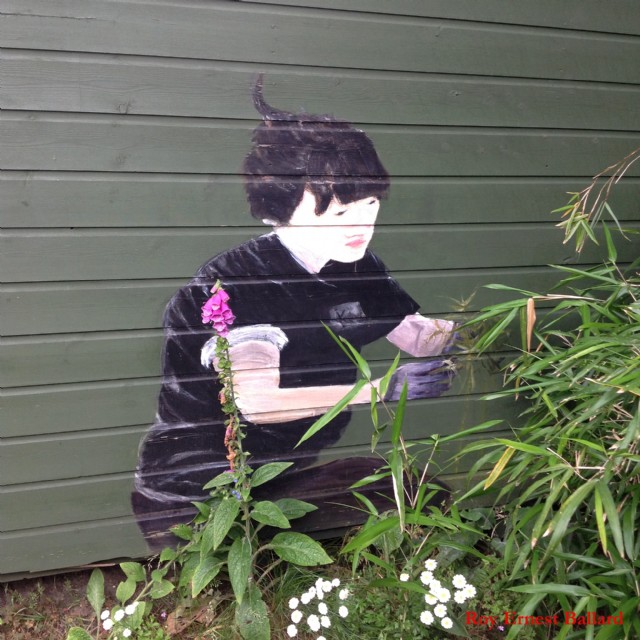
Japanese Garden
The mistress of the mini-masterpiece
was fixed upon her purpose of renewal,
her garden of Japan, her plot of peace,
her precious gem set in a royal jewel.
One day we saw her tending plants at Kew.
‘We should remember this', I think I said.
So there among the foxgloves and bamboo
I drew her in acrylics on the shed
and now she is a memory of you.
She gardens on when all the flowers are dead.
I see her toiling there the winter through.
It's not a fertile spot but some flowers grow.
She talks to them perhaps. Would it were so.
 v
v
Train passenger
She did not see the endless stands of trees,
their hollow eyes in shadows by the tracks,
through once-enchanted regions where the bees
were sealing clover honey up in wax.
She did not see the murmuration write
its fleeting charcoal message on the sky;
girls diving like kingfishers in the bright,
reflective river as the train passed by.
The chapel, listing in eternal rest
to founder in the soft, decaying earth:
she did not see. Her thoughts were unexpressed.
Perhaps she wondered what the world was worth
while she sat there with neither smile nor frown
as if a final sun were going down.
Wastes of Wishful thought
Your memory, the flower that I tend,
my insubstantial relic of desire,
grows pale despite the time of mind I spend
to bring alive a remnant of your fire.
A second's thought, a minute or an hour,
an age of recall: you are absent still.
Too much of this has made my mind run sour
and no philosophy can cure my ill
for I am lost in wastes of wishful thought
without a prayer to mend a withered rose.
The heavy weight of learning comes to naught.
The world is wearier than I supposed.
Of glorious Creation who can boast
it brings us love? It kills what we love most.
Paganini's theme
It seems to summon demons all around
with snatches of the devil's private prayers;
to fill the air with wild, disturbing sound,
with doctrines dangerous and rebel airs.
The kick and stamp and dash of heel and toe
go on until a master stroke, unplanned,
comes in to soothe the endless welts of woe,
to put a treasure in the master's hand.
The eighteenth variation changes all
as if some jungle balm made from a leaf
had turned to flowers every cannonball;
made us forget the price of love is grief;
put scarlet roses in the armoury;
turned all our conflicts into harmony.
Subscribe to:
Posts (Atom)